As hummingbirds are fairly common around the city, it was no surprise to see them feeding on the pink flowering tree opposite our balcony. I thought it might be worthwhile trying to get them to come and visit a feeder. After a failed attempt at making a feeder we decided to splash-out and buy one. We filled it with sugary-water and surrounded it with some fake flowers, as well as a real heliconia.
We took a bet on how long it'd take before they came to the feeder. I guessed 1 week and Elena 2 weeks. It took 10 days so we both won.
The first to visit a few days ago was a pair of White-necked Jacobin (Florisuga mellivora). They seem a little flighty and I wasn't quick enough to get a photo.
Then yesterday an Indigo-capped Hummingbird (Amazilia cyanifrons) male started putting in regular appearances. I'm pleased with this photo taken with the DSLR & tripod, but the bird is less than 2m away! He's virtually in our living room, which is not bad for a bird endemic to Colombia - it doesn't live anywhere else.
I'm really pleased with the feeder and hoping for a few more species of hummers. I've seen Black-throated Mango in the trees opposite, and Rufous-tailed in nearby parks, so hopefully they won't take long to visit as well.
I'm also really pleased with this Straight-billed Woodcreeper (Dendroplex picus) last week. He posed perfectly on the tree for the digiscope whilst calling loudly. Garden birdwatching Colombia style!
Wednesday, 9 May 2012
Hummers
Labels:
birding,
birds,
birdwatching,
bucaramanga,
colombia,
hummingbirds
Location: Bogota
Bucaramanga, Santander Dept, Colombia
Saturday, 5 May 2012
Common birds in Bucaramanga
As we've still not got our own car, most of my birding has been in Bucaramanga. I've seen plenty of species just from the balcony, but with access to only a small fieldguide from ProAves, it's not always easy to identify what I see. When you first start out in a new country, it can be useful to know what birds are common. Here's what I see often.
A Black Vulture or "Chulo" (Coragyps atratus). Look up in the sky at almost anytime and you'll see a few chulos circling in the thermals. They're fairly large and they also like to hang around the local market. Sometimes you nearly get close enough to trip over them.
A Ruddy Ground Dove or "Abuelita", which means little grand-mother! (Columbina talpacoti). These small doves are everywhere in Bucaramanga and something of a pest in some-places.
This is a Black-faced Grassquit or "Semillero Pechinegro" (Tiaris bicolor). They are very common like house sparrows around houses, though not in big flocks. It appears like a sparrow, but now they classify it more closely to the Tanagers and Darwin's Finches. The Proaves fieldguide comes up a little short with this bird, I couldn't recognise it at all for a while.
This one's a Thick-billed Euphonia (Euphonia laniirostris). Plenty around, very colorful with a distinctive call. They seem happy to land on the balcony.
Lastly the Orange-chinned Parakeet (Brotogeris jugularis). There are small flocks of them around the city, and they're very noisy.
Other birds that I see very often:
Turkey Vulture,
Great Kiskadee (or Bien-te-veo). A large noisy yellow flycatcher,
Tropical Kingbird,
Blue-Grey Tanager - light blue with a call like a squeeky children's toy.
Palm Tanager,
Bananaquit,
Bi-coloured Wren - large brown & white wren often in family groups with loud "cúchica" call.
Black-billed Thrush,
Shiny Cowbird,
Blue & White Swallow,
Southern Rough-winged Swallow.
Of course, out of the city there's plenty of other species, but now I've got my eye (and my ear) in to some of the commoner ones, I hope I'll recognize more.
Sunday, 15 April 2012
Ants!
San Gil is a larger town in the south of Santander. The streets are cobbled in places around the colonial style centre and some are incredibly steep. A number of companies offer adventure sports in and around the canyon. Having seen the nearby River Fonce with very powerful rapids, I can imagine the rafting and canoing is exhilarating. There's also climbing, caving, mountain biking and paragliding on offer.
The people of Santander are famous for eating “hormigas culonas” or big-bottomed ants. The fried abdomen of these giant leafcutter ants, one the largest species in the world, were traditional food of the local Guane tribes. Now they are sold by street vendors, and the ant is used as a symbol around Santander. I've not tried eating them yet, I'm waiting for the fresh harvest.
In the town is Gallineral park. It is well maintained and makes for a good visit. Just outside is a giant ant sculpture. The trees and flowers around the several small bubbling streams and the powerful River Fonce make for good pictures.
Just outside San Gil is the Pozo Azul, a small natural swimming hole which is great for cooling off. Outdoor swimming holes are dotted around the area and they are one of the big pluses for me. You might have to put up with very loud Vallenato accordion music from the cafe in Pozo Azul. Playing loud music is just part of Colombian culture unfortunately.
Not far from San Gil is the pretty colonial town of Barichara, which I like a great deal. The municipal authorities have been very strict in maintaining the character by enforcing rules on the appearance of the the buildings, the narrow cobbled streets, and the main square with its stone church.
The cafes and restaurants are also pretty good. Many of them serve roast goat, a local specialty. We were told the property prices in the town were very high, and of rumours that ex-presidents owned buildings there. I'm sure Barichara gets plenty of tourists at peak times, but it was very quiet when we went during the week. Just a few blocks from the main square are two purpose-built viewpoints with impressive vistas. You can look out over the Rio Suárez about 800m below to the next mountain range on the other side. There's a walk of about 10km to another small town nearby, Guane, which we hope to try soon.
They even have a statue and even a monument to the ants in the beautifully restored town hall!
Saturday, 14 April 2012
Panachi
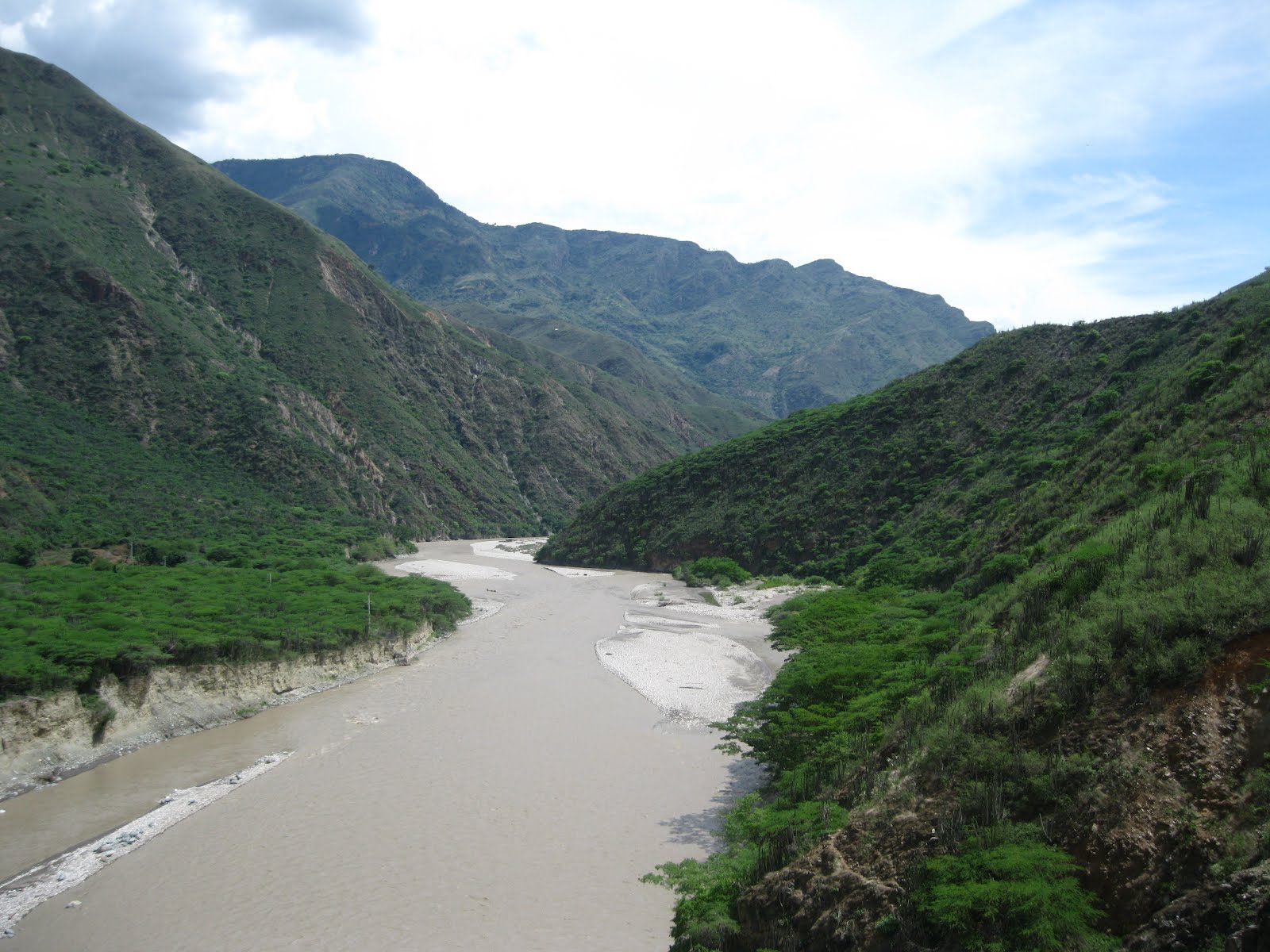
The south of Santander has some exceptional destinations for tourism and we've had a few day trips and one overnighter. There is stunning mountain scenery, colonial architecture, interesting food and a host of outdoor adventure activities. The Chicamocha canyon is an attraction on a grand scale and together with the area around it provides a great place to visit. Here, the Chicamocha river has cut a deep canyon into the mountains and it makes a u-turn, winding around a place called Pescadero before joining the Sogomoso River. The canyon seems to have its own climate and is much drier than surrounding areas, so there's much more cactus and desert type scrub amongst the open rocks.
At Pescadero, the road from Bucaramanga to Bogotá climbs a series of hairpins before reaching Panachi – Parque Nacional del Chicamocha – and then goes on south to San Gil. The visitors centre perched on the mountain is well worth stopping for, even if the entrance fee seems high. The panoramic views are superb.
The enormous sculpture commemorating the “Revolt of comuneros” of Santander who started an uprising against tobacco taxation in 1781, is also very impressive. The sculpture represents a tobacco leaf, on which are posed various larger-than-life size figures with dramatic expressions making it a little disturbing when you stand amongst them.
There are a few attractions in Panachi for the adrenaline junkies – two long zip-wires, a couple of very large swings which take you out over the cliff edge, a zorb track and more attractions are being developed. There is also a cable car running across the canyon for a distance of about 6km to the Mesa de Los Santos. This 25 minute each-way trip is a great way to see the canyon closer-up.
At Pescadero, the road from Bucaramanga to Bogotá climbs a series of hairpins before reaching Panachi – Parque Nacional del Chicamocha – and then goes on south to San Gil. The visitors centre perched on the mountain is well worth stopping for, even if the entrance fee seems high. The panoramic views are superb.
The enormous sculpture commemorating the “Revolt of comuneros” of Santander who started an uprising against tobacco taxation in 1781, is also very impressive. The sculpture represents a tobacco leaf, on which are posed various larger-than-life size figures with dramatic expressions making it a little disturbing when you stand amongst them.
There are a few attractions in Panachi for the adrenaline junkies – two long zip-wires, a couple of very large swings which take you out over the cliff edge, a zorb track and more attractions are being developed. There is also a cable car running across the canyon for a distance of about 6km to the Mesa de Los Santos. This 25 minute each-way trip is a great way to see the canyon closer-up.
Subscribe to:
Posts (Atom)