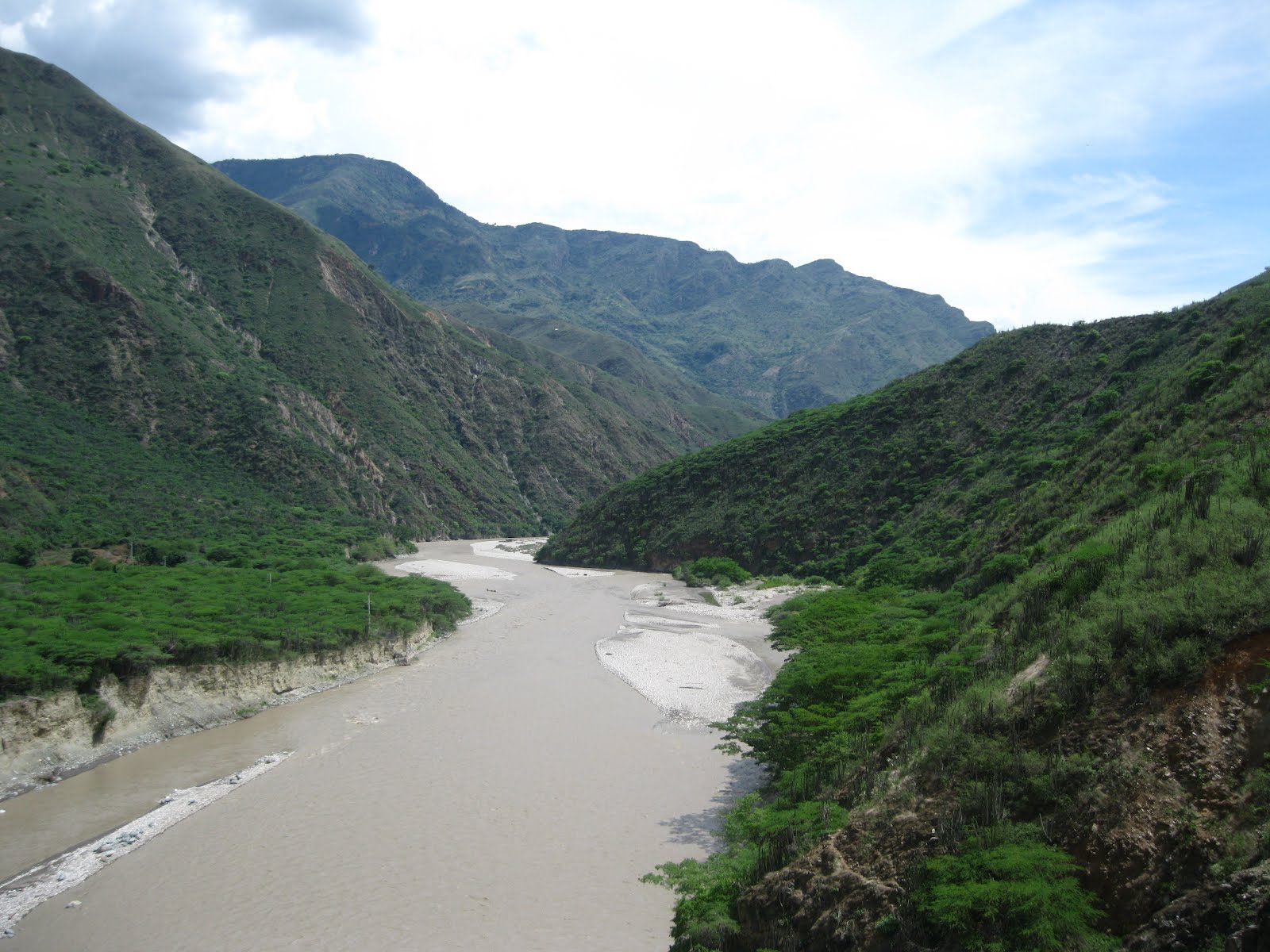
This Sunday we went for another walk, this time with a group of about 20 others, organized via Facebook, or “Face” as they call it here. We took a bus on the main road from Bucaramanga towards Bogotá and stopped about half-way between Piedacuesta and Aratoca just north of the Chicamocha National Park in Santander. Leaving the main road there we walked along a gravel road up and over a ridge and down into the valley of the Rio Umpalá. Umpalá means place of the gods (sólo van los dioses) in the local Guane language.

As we left at around 9.30, this first section of the walk was hot, and on a dirt road through a dry scrub landscape fairly typical in the area of Chicamocha canyon. We climbed up and over a ridge. Although the views were good, there was not so much wildlife to see except, sadly, a dead armadillo; I've yet to see one alive. There were also good views of white-collared swifts zooming around close to the ground. These are large, fast birds with great aerobatic skills as they catch insects on the wing and often forming impressive flocks.

Near the top was this slightly strange looking cactus, at least from this angle! Some of these cactus have small red fruits which I thought I'd taste. The fruit had no large spines, but does, I discovered afterwards have lots of very small spines which are painful once they get into your hands. It tasted sweet & tasty, but I won't do that again! Later, one of the walkers gave us a fruit of another type of larger cactus, which had no spines. Although some people were eating the skin, we peeled it, and the grey, seed-filled pulp had a pleasant taste and texture something like a watermelon.

The Umpalá valley was an oasis of green and the small fast-flowing river was turbulent and cool, having come from the mountains above about 3000m. On our way into the valley we could see a large waterfall on the other side which would be well worth a visit although it looks very difficult to get there.

At the river, the swim was very refreshing, the air cooler by the river and we ate our lunch sitting on a rock cooling our feet. Whilst we were eating someone noticed a Basilisk Lizard on a rock. They managed to coax it into the water where it lived up to its name of Jesus lizard by running across the river. This was an impressive feat given the fast flow. It's great to be watching wildlife I only ever saw on television in the UK.

At the river, the swim was very refreshing, the air cooler by the river and we ate our lunch sitting on a rock cooling our feet. Whilst we were eating someone noticed a Basilisk Lizard on a rock. They managed to coax it into the water where it lived up to its name of Jesus lizard by running across the river. This was an impressive feat given the fast flow. It's great to be watching wildlife I only ever saw on television in the UK.

There are many small farms in the valley growing a variety of crops, including tobacco, plantains and cocoa as well as keeping plenty of goats. However, the village of Umpalá is very small, with just a tiny church and a few colonial style houses several of which were abandoned. It wasn't deserted however and the local shop served very welcome cold beer. They put on some music and some of the walkers started dancing, as Colombians are apt to do at any time.
The rest of the walk was along the river through small fields with a narrow, and sometimes muddy track crossed by many irrigation ditches and pipes. There were many more birds to see, though we ran out of time, and my only new bird I could identify was a Pearl Kite (Gampsonyx swainsonii), a tiny white-breasted falcon-like raptor. There was also another Highland Motmot, but I had no time to get a photo.

Around 4pm we arrived back at the main road from Bogotá to Bucaramanga at a place called Mensuli where there is a restaurant, campestre and a swimming hole. To get to the bus, we had to cross the river twice, first by a rickety wire & wooden suspension bridge, and then by a log with bamboo hand-holds. A local woman crossed confidently carrying large bags, so we thought we couldn't show any fear.
It was a good day's walk, and I'd recommend the Umpalá valley if you enjoy seclusion. As the first part of the walk was a little hot & less interesting, it might have been better just to go out and back from Mensuli. Walking in a group has many advantages; the security, the chance to get to know different people and not least, the chance to discover new routes which are hard to find in Colombia with few marked paths. With Facebook & the internet gaining all the time here, I get the feeling more walking clubs are getting “organised” that way, if ever that were possible in Colombia ;-)